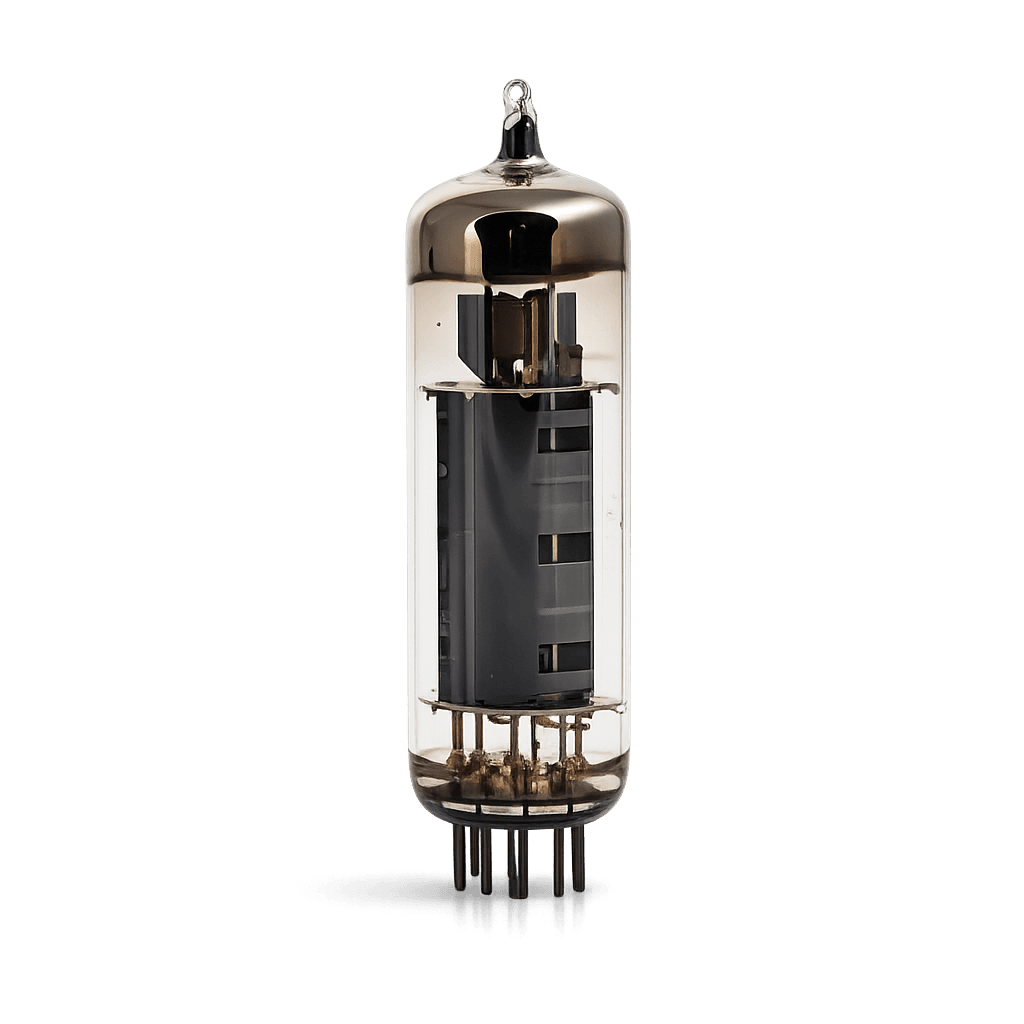
Valve People Understand: Why Vacuum Tubes Still Have Us Glowing
A short reflection on why vacuum tubes still matter to music listeners, musicians, restorers and hi-fi enthusiasts.
Glass Audio29 November 2026

Your cart
0 items
Your profile
Sign in to access your account.
Sign in to view your orders, manage your account details, save addresses, and enjoy a faster checkout experience.
Your cart
0 items
Your profile
Sign in to access your account.
Sign in to view your orders, manage your account details, save addresses, and enjoy a faster checkout experience.
E88CC and 6922 are commonly paired designations, but a tube-family label is not a blanket substitution approval. Check the exact valve, its manufacturer’s data and the amplifier’s requirements. A nine-pin base alone does not establish compatibility.
This Glass Audio guide explains how to compare published specifications. It does not describe measurements of individual valves or promise that any particular valve will suit your equipment.
Record the amplifier make, model, valve position and full marking on the existing valve. Use the equipment manufacturer’s specified replacement type. If the manual permits alternatives, follow any restrictions for that particular position. A previous owner’s fitted valve may itself be incorrect.
ECC88 / 6DJ8 and E88CC / 6922 are related families often grouped together by shops. That grouping helps browsing; it does not establish that every historical or modern version has the same ratings. Treat a replacement recommendation as specific to the circuit and exact product.
The following values come from the manufacturers’ own sheets, rather than a generic equivalence chart. They are published model specifications, not Glass Audio test results.
Construction Double triode, NOVAL base Miniature twin triode Nominal heater voltage 6.3 V 6.3 V Heater current 300 mA 335–385 mA specified range Plate dissipation limit 1.5 W per section 1.8 W per sectionEven these two related products do not specify identical heater current. Check the remaining limits, heater-to-cathode voltage, pin connections and operating conditions in the complete sheet. A higher individual limit does not make a valve universally suitable or a better-sounding choice.
A typical operating point describes the conditions under which characteristics are quoted. A maximum or limiting rating is a boundary subject to the manufacturer’s stated conditions. It is not a recommended bias setting, nor permission to combine every maximum simultaneously. Circuit gain also differs from the valve’s published amplification factor.
Sometimes an equipment manufacturer permits this, but confirm approval for your model and valve position. Do not infer approval from a seller’s category name, socket fit or an online list.
No. A designation identifies a type, not a measurement relationship between individual valves. If your equipment requires matching or balanced sections, ask what was measured and under which conditions before buying. This guide makes no matching claim for the products linked below.
Do not substitute it on appearance. A familiar nine-pin envelope is insufficient: heater wiring, electrode connections, electrical characteristics and circuit requirements must all agree.
See the actual Glass Audio listings for JJ E88CC / 6922 and Electro-Harmonix 6922EH. Check current availability on each listing. Send the equipment model, valve position and markings through our contact page when making an enquiry.
Safety: valve amplifiers can retain lethal voltages after switching off and unplugging. Do not open the chassis, probe circuitry or attempt bias adjustment without appropriate training. Refer internal work to a qualified valve-equipment technician.
Sources checked 15 October 2026. Original PDFs remain with their publishers; no redistribution permission is implied. For an initial reference, also see our valve equivalent finder, subject to its compatibility warnings.
A short reflection on why vacuum tubes still matter to music listeners, musicians, restorers and hi-fi enthusiasts.
Understand heater requirements, maximum ratings, typical operating points and characteristic curves. Learn what a valve datasheet can and cannot establish about compatibility.
Compare ECC83, ECC81 and ECC82 valve characteristics and learn why similar bases and gain figures do not establish safe interchangeability.