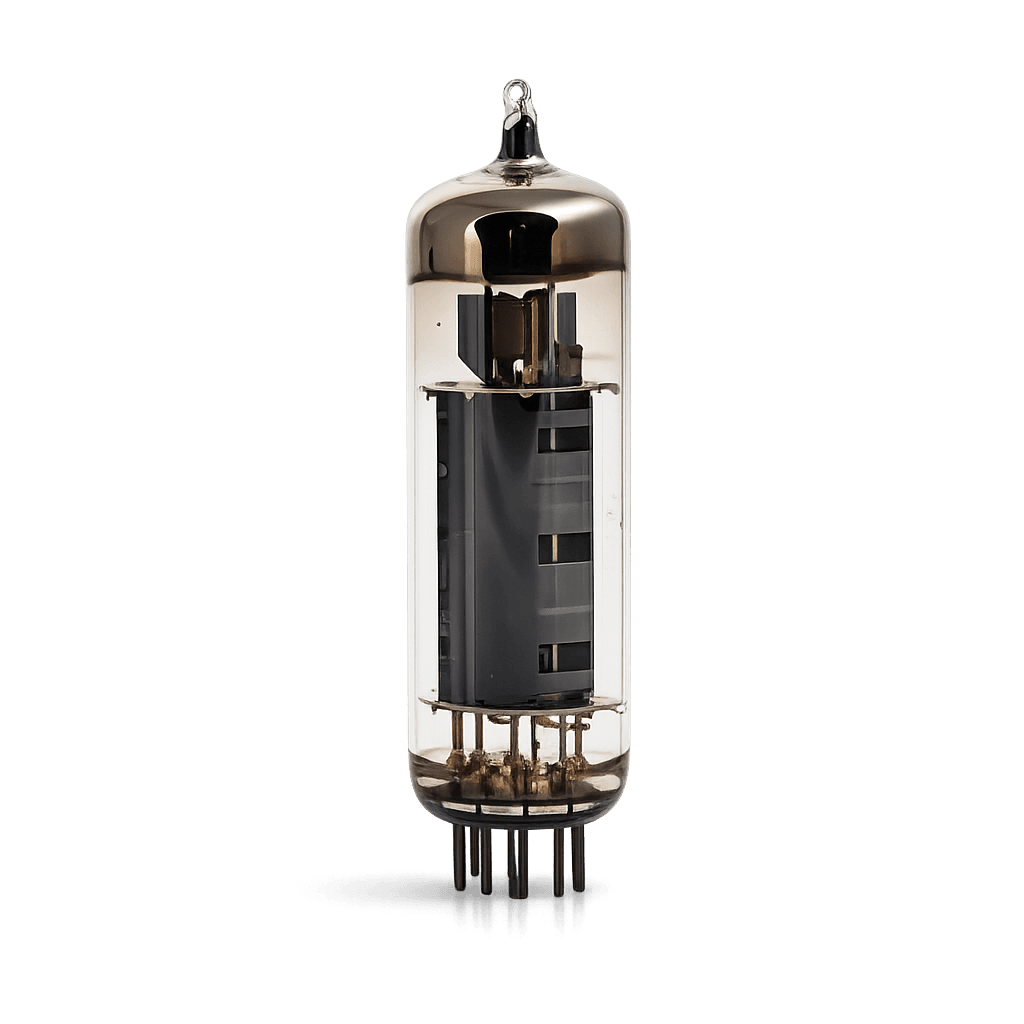
Valve People Understand: Why Vacuum Tubes Still Have Us Glowing
A short reflection on why vacuum tubes still matter to music listeners, musicians, restorers and hi-fi enthusiasts.
Glass Audio29 November 2026

Your cart
0 items
Your profile
Sign in to access your account.
Sign in to view your orders, manage your account details, save addresses, and enjoy a faster checkout experience.
Your cart
0 items
Your profile
Sign in to access your account.
Sign in to view your orders, manage your account details, save addresses, and enjoy a faster checkout experience.
The 12AX7/ECC83, 12AT7/ECC81 and 12AU7/ECC82 families contain dual triodes commonly found in audio equipment. Their similar appearance can be misleading. A circuit designed around one family may bias and perform very differently with another.
These are manufacturer characteristics, not measured Glass Audio stock results and not the voltage gain of an amplifier stage. The different test conditions themselves show why a mu-only comparison is incomplete. They must not be generalised to every historical or current brand.
Changing the valve can change current, bias, loading, headroom, frequency response and distortion. The circuit's resistors, coupling and feedback were selected for particular conditions. A lower mu number does not prove a valve is safer, quieter or more suitable, and a higher number does not promise a louder or better amplifier.
Even where the heater arrangement appears similar, other limits differ. In the cited JJ sheets, the ECC81 heater-to-cathode voltage limit is 90 V; the ECC83S and ECC82 sheets give 180 V. This manufacturer-specific example can matter where the cathode sits well above the heater reference. Read the complete documents and their rating conditions.
Start with the amplifier manufacturer, model, valve position and specified replacement type. Follow the equipment documentation, including permitted alternatives. If a change is not documented, obtain circuit-specific advice from a qualified technician rather than relying on a generic equivalence list.
They are commonly paired US/European designations. Check the exact manufacturer model and equipment requirements, especially suffixes and specialised variants.
There is no universal approval. A substitution may move the circuit to an unsuitable operating point.
No. It is an electrical characteristic. Listening outcomes depend on the circuit, load, operating conditions and condition of the valve.
Follow manufacturer-approved owner procedures. Do not open or work inside a high-voltage amplifier without the necessary competence. Internal diagnosis, modifications and bias adjustment require a qualified technician; dangerous stored voltages may remain after unplugging.
Further reading: how to read a datasheet and E88CC, 6922 and 6DJ8 compatibility.
Browse current 12AX7 / ECC83, 12AT7 / ECC81 and 12AU7 / ECC82 listings. For a specific enquiry, include your amplifier model and valve position when contacting Glass Audio.
A short reflection on why vacuum tubes still matter to music listeners, musicians, restorers and hi-fi enthusiasts.
Compare E88CC, 6922 and 6DJ8 valve families using manufacturer datasheets. Understand heater requirements, ratings and safe compatibility checks before buying.
Understand heater requirements, maximum ratings, typical operating points and characteristic curves. Learn what a valve datasheet can and cannot establish about compatibility.